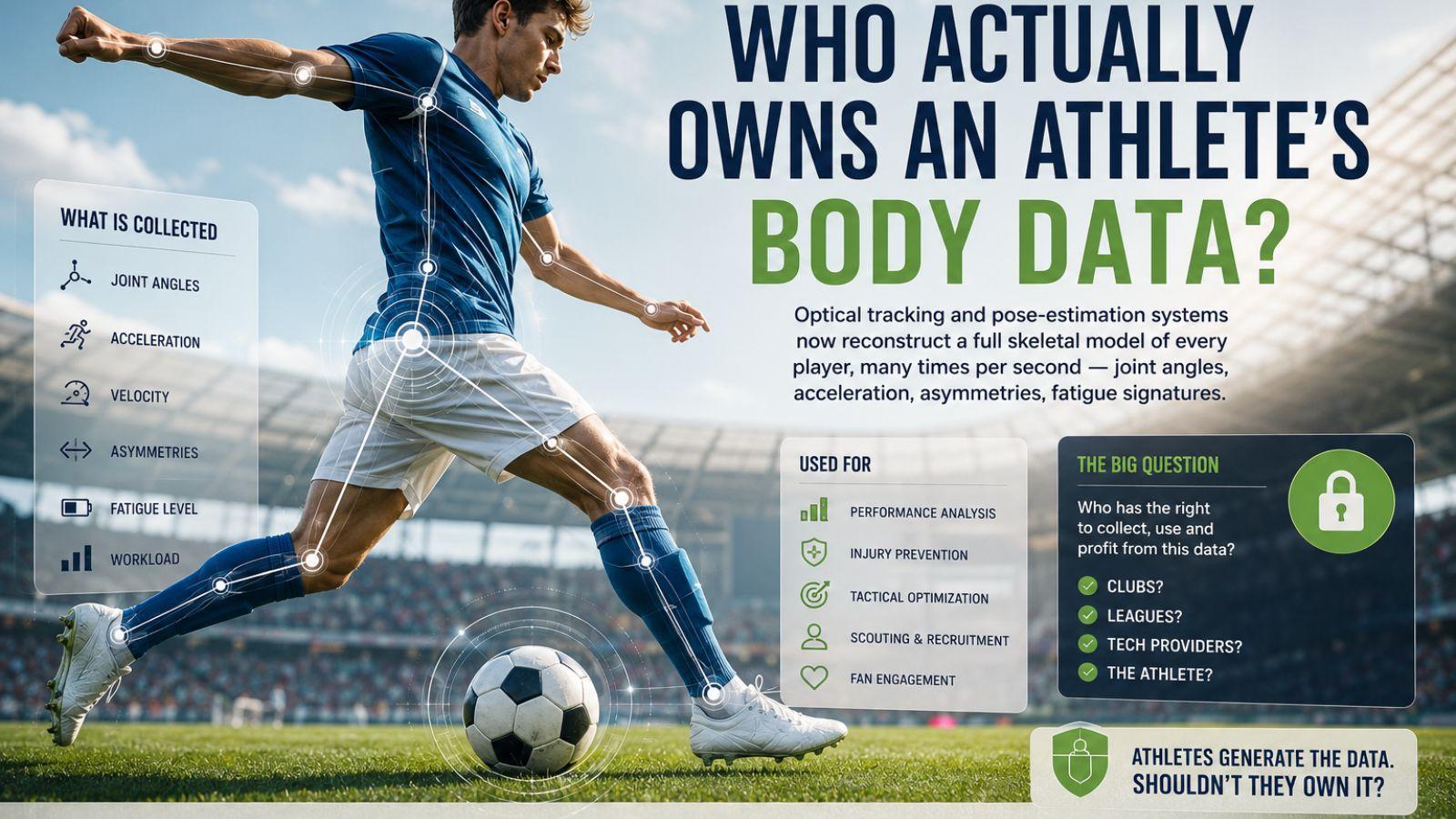
Every time a striker times a run at the World Cup, twelve cameras under the stadium roof are rebuilding their body as a moving cloud of points. The system that produces a tidy offside line on the giant screen is, underneath, one of the most invasive biometric instruments ever pointed at a workforce — and almost nobody who watches the replay stops to ask who owns what it captures. For analysts and football bettors, these vast datasets have become increasingly valuable, helping to identify performance trends, fitness levels and tactical patterns that can influence match predictions. Insights like these are one reason many fans look for the latest NetBet bonus code, hoping to make more informed betting decisions based on deeper statistical analysis rather than intuition alone.
That is the question the technology has badly outrun. The skeletal stream a footballer generates simply by playing is among the most intimate records a human being can produce. It can flag a hamstring tear or a decline in sharpness before the player feels a thing. It is collected, stored, sold onward, and occasionally weaponised — and the law has barely decided whose it is.
What the cameras actually capture
The visible tip is semi-automated offside technology, used at the 2022 World Cup in Qatar. It uses 12 dedicated tracking cameras mounted beneath the stadium roof to follow the ball and up to 29 data points on every player, 50 times per second, calculating each one’s exact position on the pitch. Those 29 points are not abstract — they cover the limbs and extremities relevant to an offside call.
The ball is part of the rig too. The Al Rihla match ball carried an inertial measurement unit at its centre, sending motion data to the video room 500 times per second to pin down the precise moment of the kick. Combine the limb-tracking and ball data, run it through AI, and the system raises an automated offside alert — far faster than the old manual line-drawing, which leaned on broadcast frames capped at 50 per second.
Sold to fans as a refereeing upgrade, this is in reality a continuous, centimetre-accurate biomechanical record of how a professional moves for a living. And in-match optical tracking is only the public half. In training, clubs strap players into GPS and accelerometer vests; the same family of systems feeds tactical analysis, recruitment models and medical departments. What began as a line-call gadget has become a permanent file on the athlete’s body.
The data that knows you’re breaking first
Here is where ownership stops being academic. Optical pose estimation does not really store video; it stores geometry— per-frame 3D coordinates for each of the ~29 tracked joints, from which a pipeline derives the quantities that actually matter: joint angles, segment angular velocities and accelerations, ground-contact times, and inter-limb timing. Sampled at 50 Hz, that is a high-resolution kinematic time series of every stride, cut and landing a player makes. Fuse it with GPS and accelerometer load data and the medical record, and you no longer have a performance tool — you have a predictive medical instrument.
Football’s two signature injuries show how specific the signal gets. Hamstring strains cluster in the terminal swing phase of sprinting, where the muscle absorbs peak eccentric load, and they leave fingerprints in late-swing knee-extension velocity and in left–right asymmetry of stride mechanics. ACL ruptures are preceded, in many models, by dynamic knee valgus — the inward collapse of the knee during deceleration and change of direction — which pose data quantifies directly as a frontal-plane joint angle. Layer on cumulative exposure metrics — high-speed-running distance, sprint and acceleration/deceleration counts, accelerometer-derived PlayerLoad, and the acute-to-chronic workload ratio that flags when recent load outruns the body’s conditioned baseline — and you can build an individualised risk profile that updates session by session.
The method is the point. These systems do not look for a population-wide red line; they learn each athlete’s personal baseline and flag statistical deviation from it — anomaly detection layered over machine-learning classifiers trained on labelled injury histories. And the output is deliberately probabilistic, not deterministic: injuries are rare, multifactorial events, the training data is badly class-imbalanced, and even strong models trade false alarms against missed cases. But “elevated probability” is more than enough to change how a player is treated.
Read it from the player’s side. A risk score can be generated, and routed to the coaching and medical staff, before the player feels anything at all. Lawyers have already war-gamed the conflict, and reach instinctively for a football example: a player consents to wearables for injury prevention, the model flags a raised risk of muscle tears, the staff can see it — and the player’s agent begins to fear the same number will quietly depress his market value. The club points, fairly, to the benefit of pre-empting injury. Both are true at once, which is exactly why it is a fight.
The route from data to money is mundane. A player load-managed because his metrics show accumulating fatigue plays fewer minutes, and fewer minutes weaken the next contract. An injury-risk flag, once it exists in a database, is discoverable, leakable, and hard to un-know; injury history erodes bargaining power even when it was accessed without consent. The asymmetry is the whole problem: the employer holds a richer, earlier, model-driven picture of the player’s body than the player or the agent across the table — and increasingly knows the trajectory of his decline before he does.
Who owns it? A presumption that’s easy to sign away
The intuitive answer is that you own data generated by your own body. The legal reality is softer. A player is generally presumed to own the biometric data from a personal wearable — but those rights can be signed away through a contract, and if the club provides the device, the club may claim the data outright. Most football contracts, much like the image-rights deals of three decades ago, simply do not set out terms for performance and tracking data at all, leaving a vacuum where there should be a clause.
That vacuum is widest where players have least leverage — academy and lower-league footballers, who are monitored as intensively as stars but have no standing to negotiate over what becomes of the file.
When the data follows the money
The commercial pull is what turns a privacy concern into a market. Football’s performance data is aggregated by specialist firms and sold onward: companies such as Opta and Genius Sports amass it and distribute it to broadcasters and betting operators worldwide, and in 2019 Genius Sports secured exclusive rights to supply live match statistics to bookmakers globally. The players whose limbs generate that data see no direct cut.
That clause is what set off the most significant revolt in the sport. Project Red Card, run by the Global Sports Data and Technology Group and co-founded by former manager Russell Slade and technologist Jason Dunlop, argues that under UK and EU data-protection law a footballer’s performance data is personal data being processed for commercial gain without consent — and is therefore unlawful. By late 2021 the campaign had grown to around 850 current and former players, with “letters before action” sent to 17 betting, entertainment and data companies and many more in the pipeline, the players seeking compensation and an annual fee for six years of commercial use, the limit under the UK statute of limitations.
The betting dimension is double-edged. Bookmakers prize this data precisely because it can predict performance and move odds, and players consenting to collection are often unaware their data may reach gambling firms at all. Even a player who sells his own data is not safe: if that information could create asymmetric advantage in betting markets, sharing it could be construed as facilitating gambling and breach the sport’s own integrity rules.
The law is catching up slowly
Europe’s regime is the sharpest tool available, and it was not designed for this. Under GDPR, ordinary statistics — appearances, goals, distance covered, top speeds — count as personal data, while medical, genetic or biometric information is “special category” data with stricter protection. Clubs acting as data controllers typically lean on consent obtained through player contracts, or argue processing is “necessary,” to establish a lawful basis. The likely defence from data and betting firms is “legitimate interests”: that fans’ interest in seeing the numbers outweighs the player’s rights — a three-part balancing test that has never been cleanly resolved in this setting.
Even sympathetic lawyers doubt litigation pays off for players. One analysis warned that a successful claim might merely redirect betting and gaming income without net benefit — money that would otherwise flow back to clubs, with a share going to the lawyers and funders behind the case — and that transparency and accuracy problems are better fixed through the right to rectification and regulatory enforcement than through a payout.
What a fair settlement might look like
Football already has the template, and it is image rights. Because England’s image-rights protection was weak, the players’ body FIFPro historically pursued video-game makers such as EA Sports in Germany, where the regime was robust; the upshot is that developers now pay licence fees to use Premier League names and likenesses even where UK law would not strictly require it. Performance data could be treated the same way — as a licensable right that defaults to the player, who then sets terms.
Translating that to stadium optical tracking is the unsolved part, because the player cannot switch it off: the skeleton is captured by the arena, not by a strap they chose to wear. A credible framework would need three things written into standard contracts and league rules: an explicit default of player ownership; hard firewalls, with teeth, separating health-and-performance use from contract and transfer decisions; and transparency strong enough that a player knows every downstream recipient — above all the betting operators — before a single frame is processed.
None of this is technically hard. The cameras already rebuild the skeleton, the databases already exist, and the legal categories are mostly written. What is missing is the decision — before the next generation of systems makes the question moot — that the most detailed record ever made of how a footballer’s body works should belong, first, to the footballer.