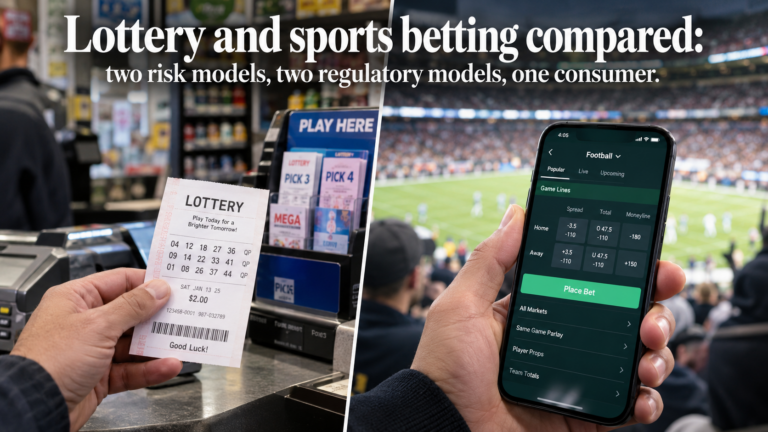
Lotteries and sports betting are regulated as if they were separate industries, one a public-good monopoly and the other a licensed commercial market. The risk evidence does not follow that line. What predicts harm is how quickly a product resolves and how soon a player can go again, not the name on the ticket. In 2026 the courts started saying so out loud. Understanding these differences can help players make more informed betting decisions, including when evaluating promotions such as a Pennsylvania lottery bonus code. Looking beyond the offer itself and considering how the product works can lead to a more reasoned approach.
The money leaves at two different speeds
A lottery ticket is an expensive single transaction. In the year to 31 March 2025, British National Lottery sales reached £7.886 billion, of which 55 pence in every pound went out as prizes, 23 pence was payable to good causes, 12 pence went to duty, three pence to retailer commission and seven pence to costs and profit. The player surrenders roughly 45 pence of every pound, once, and then waits for a draw. A sportsbook works in reverse. The margin on each wager is thin, but stakes recycle, because winnings become the next bet. In the final quarter of 2025, turnover across Britain's remote casino, betting and bingo sector reached £39.18 billion and produced £2.12 billion in gross gambling yield, an aggregate of about five percent across all three verticals rather than a betting-only margin. The lottery takes a large bite out of a small number of pounds. The sportsbook takes a small bite out of the same pound, repeatedly.
Speed, not product type, is what the risk data tracks
Britain has the cleanest evidence on this, and it complicates the usual story. Among people gambling weekly on activities beyond lottery draws, 17 percent scored eight or more on the Problem Gambling Severity Index, against one percent of those gambling weekly on lottery draws alone. At first glance that reads as a straightforward verdict on lotteries versus everything else. The detail undoes it. Weekly sports betting, once in-play wagering was stripped out, showed no significant relationship with PGSI scores at all, while weekly in-play betting carried a likelihood of scoring eight or more that was over three times higher. In-play is the variable, not sports betting. The mechanism identified is rapid rewards and continuous play, the same property that makes slot machines the other outlier in the data. The finding that gets quoted least is the one that should unsettle both camps. Weekly participation in National Lottery online draws was associated with lower PGSI scores, while weekly online betting on the outcome of non-sporting events carried odds of a score of eight or more nearly three times higher. Two products, both sold as a flutter on an uncertain event, landing at opposite ends of the risk distribution.
Why the rulebooks diverged in the first place
European law built the split deliberately. Member states may hand exclusive rights to a single lottery operator, and the justification accepted at EU level has always been channelling, the argument that funnelling demand through one tightly supervised body controls risk better than competition does. Sports betting, harder to defend as a natural monopoly, was opened to licensing across most markets. That architecture was tested again this year. On 16 April 2026 the Court of Justice of the European Union ruled in Case C-440/23 on Germany's authorisation regime for online games of chance and secondary lotteries. EU law does not prevent a member state from prohibiting online services licensed elsewhere in the Union, and a consumer may reclaim stakes lost with operators established in another member state where the games were prohibited at home. Secondary lotteries, where a private firm takes bets on the result of a state draw, fell inside the prohibition. The same event, sold as a bet rather than a ticket, moves into a different legal universe.
How far apart the rules have drifted by 2026
Britain now prices the two products as though they carry different social costs. The statutory levy in force since April 2025 charges online operators 1.1 percent of gross gambling yield and society lotteries 0.1 percent, and exempts the National Lottery entirely. Duty diverges further. Lottery duty stays at 12 percent of ticket sales, remote gaming duty rose from 21 percent to 40 percent on 1 April 2026, and a new 25 percent remote betting rate within general betting duty arrives on 1 April 2027, with remote bets on UK horseracing held at current rates. The stated rationale was to discourage operators from steering consumers toward products associated with greater risk and harm. Tax is now being used as a harm proxy. Age limits show the same fault line more bluntly. Belgium standardised its minimum gambling age at 21 across casinos, betting, arcades and bingo, while leaving the National Lottery accessible from 18. In the Netherlands, a reform bill raising the minimum age to 21 for high-risk games and adding a cross-operator deposit limit advanced through parliamentary committees in early 2026, and the Dutch remote licence already prohibits bets on lottery outcomes, remote lotteries and bets on non-sporting events. A Belgian nineteen-year-old can buy a scratchcard and not a coupon.
The categories are collapsing faster than the law can follow
Belgium's Constitutional Court said as much in judgment 165/2025. The exemption granted to the state operator was ruled unjustified, on the basis that some online lotteries have become increasingly gamified and have taken on the audiovisual presentation of privately operated games. The legislator has until 31 December 2026 to deliver a level playing field where both sides offer similar products. The argument that the lottery product had moved came from a regulator, not from an operator lobby. The United States is running the same collision through a different door. Sports event contracts on prediction markets are gambling to state regulators and derivatives to the platforms, and the federal courts have now produced a circuit split. On 6 April 2026 the Third Circuit held that sports-related event contracts are swaps and that federal law preempts New Jersey's gambling statutes. On 28 August 2026 the Ninth Circuit ruled the opposite way, finding that such contracts are not swaps and that federal law does not preempt state gambling regulation. Sports contracts have made up roughly 80 percent of Kalshi's volume since July 2024, so the stakes in resolving that contradiction are commercial as well as doctrinal.
One consumer, moving between rulebooks nobody designed together
None of these boundaries exist for the person holding the phone. National Lottery sales hit £8.1 billion in 2025, with digital reaching £4.1 billion and accounting for 51 percent of the total, the first time online has passed half in the lottery's 31-year history. The lottery is an app now, on the same device, funded by the same card, sitting a thumb's width from a sportsbook. What does not travel with that consumer is protection. Deposit limits, affordability triggers, self-exclusion registers and advertising restrictions attach to product categories drawn for reasons of tax history and public finance, not resolution speed. The Dutch cross-operator deposit limit is the only mechanism in this piece that follows the person rather than the product, which is probably why it took five years to draft. The regulatory question worth asking is not whether lotteries are safer than bookmakers. It is why a rulebook still sorts by product name when the data sorts by how fast a bet settles. Which way would you expect Brussels and Westminster to move first, harmonising upward or defending the exemption?