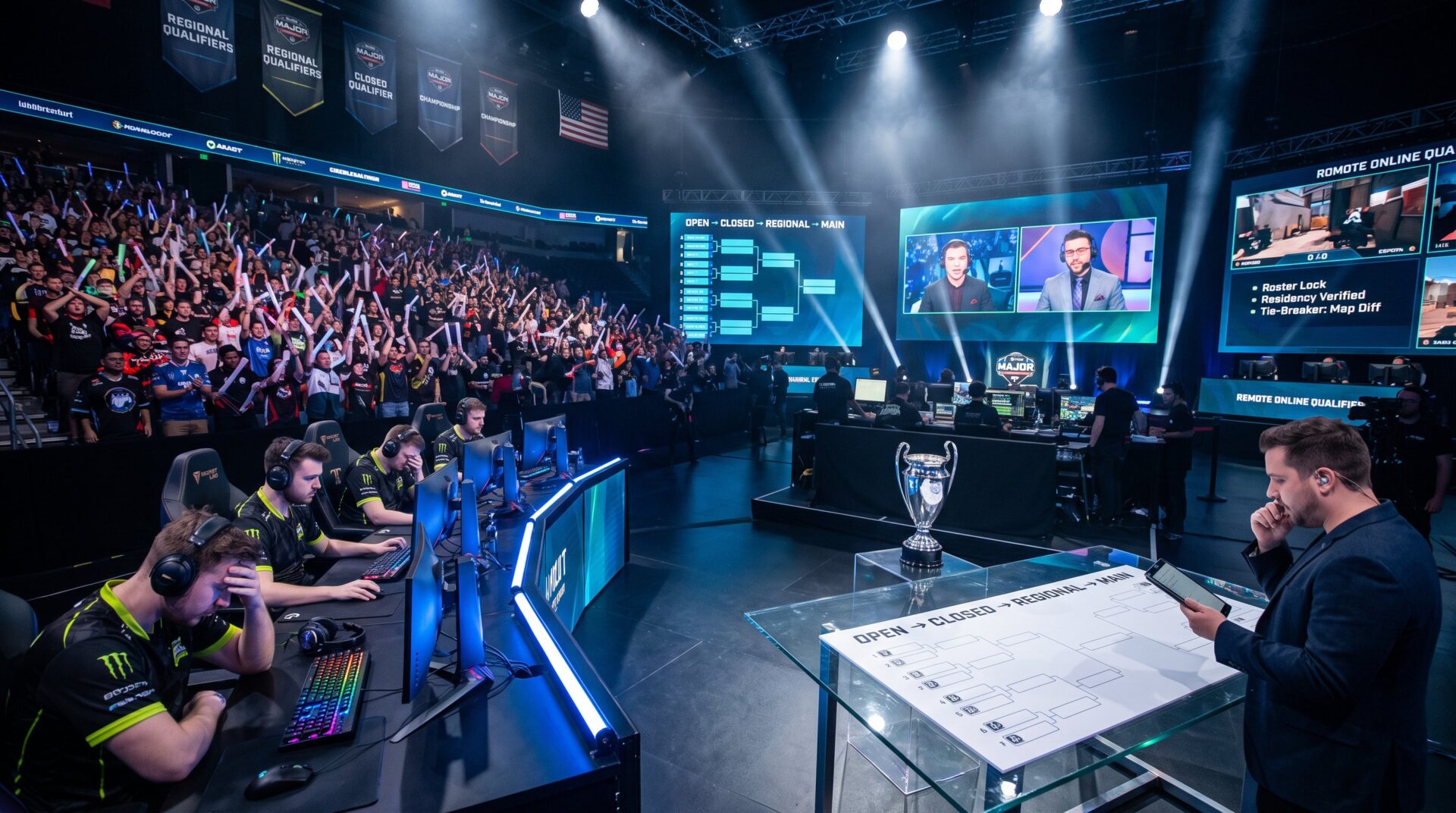
How Esports Tournaments Work from Qualifiers to Finals begins with tens of thousands of hopefuls and ends with one championship team under bright lights. The pipeline is predictable: open entry points, filtered qualifiers, structured group play, bracketed playoffs, and finals that award prize pools and circuit points. This guide explains each stage in clear steps, shows why organizers choose specific formats, and surfaces practical rules, eligibility, seeding, ties, and prize distribution, that shape competitive outcomes in 2026.
Key Takeaways
- Esports tournaments progress from open local ladders through regional leagues to global majors, creating a structured competitive pyramid.
- Registration and eligibility rules, including roster locks and residency proofs, ensure fair competition and influence who advances to qualifiers.
- Four main formats—single elimination, double elimination, round robin, and Swiss—are chosen based on speed, fairness, and player experience needs in different tournament phases.
- Seeding and tie-breaker rules prevent early clashes between top teams and use criteria like head-to-head results and map differences to decide advancement.
- Main events combine group stages and playoffs using formats like Swiss and double elimination, enhancing viewer engagement with production elements and live audiences.
- Finals feature long series with tiered prize pools that reward placement and performance, while post-event processes update standings, contracts, and prepare teams for new seasons.
How Esports Tournaments Are Structured: From Local Ladders To Global Events
Fact: Esports tournaments form a three-tier pyramid, local ladders, regional leagues, and global majors. Local ladders run on platforms like Challonge or in-game leaderboards. They let players climb ranked pools and qualify for weekend cups: a single local ladder might serve 2,847 active entrants in a month for a popular title. Regional leagues collect top ladder finishers and invited teams into structured seasons. Winners from regionals earn spots in international events. At the apex sit global championships, The International, VALORANT Champions, and similar Majors, where organizers reserve invites, seed top teams, and open a few slots via qualifiers.
Context and example: A player moves from a 128-team open bracket to a regional qualifier, then to a closed qualifier, and finally to a Major. That journey explains why organizers invest in ladder integrity, anti-cheat, and regional servers: they must produce fair, verifiable results that scale from hundreds to millions of spectators.
Registering, Eligibility And The Road To Qualifiers
Fact: Registration and eligibility gate who may compete. Organizers require roster submission, contact details, and sometimes deposit fees. Eligibility rules usually include age minimums, region locks, and rank/MMR thresholds. Teams often face a roster lock date two to four weeks before qualifiers.
Practical details: A tournament portal will ask for player IDs, nationalities, and proof of residency for regional slots. Competitive integrity rules ban smurf accounts and enforced suspensions apply. The typical path reads: open ladder → open qualifier → closed/regional qualifier → main event → finals.
Warning: Missing a roster lock or supplying the wrong residency documents will result in disqualification: one professional team lost a regional slot in 2024 due to a late paperwork change. For training and lifestyle context, organizers link rules to broader player routines, see a concise training day overview that outlines how teams prepare for long qualifier windows.
Format Details: Single Elimination, Double Elimination, Swiss And Round Robin
Fact: Four formats dominate and each solves different problems: speed, fairness, and room for error. Single elimination ends a team after one loss, fast, low-cost, high drama. Double elimination uses winners and losers brackets: a second loss removes a team and the format reduces variance. Round robin puts every team against every other, maximizing fairness but increasing match counts. Swiss pairs teams with identical records for multiple rounds without full round-robin volume.
When to use which: Single elimination fits smaller open qualifiers with 128+ entrants. Double elimination suits LAN playoffs where organizers want a safety net for favorites. Round robin is common in leagues with stable rosters and commercial broadcast schedules. Swiss is rising for qualifiers and early group phases: it balances match quantity and competitive clarity.
Human note: Players dislike single elimination early: one server disconnect can end months of effort. Organizers balance budget, broadcast time, and player experience when selecting formats.
Seeding, Bracket Creation And Tie-Breaker Rules
Fact: Seeding sorts teams to avoid early marquee matchups. Organizers seed using rankings, past results, or qualifier performance and then auto-generate brackets to separate top teams.
How it works: Seed one enters opposite seed two, seed three opposite seed four, and so on. Brackets can be fixed or use dynamic pairing between rounds. Tie-breakers vary: head-to-head results come first, then map or game difference, and finally dedicated tiebreaker matches or strength-of-schedule metrics. Some events use map differential measured to two decimal places for precision.
Example: In a six‑team group where two teams tie at 3–2, the tournament used head-to-head then map difference, requiring one team to play a sudden-death tiebreaker. Practical lesson: Teams should treat every map as consequential, not just match wins: map difference can decide advancement.
The Main Event: Group Stages, Playoffs And Viewer Experience
Fact: The main event layers group stages with playoffs to produce a compelling viewer arc. Group stages sort teams into upper and lower seeds for playoffs: playoffs use bracket formats (often double elimination). Group formats include Swiss, single or double round robin depending on time and broadcast needs.
Viewer experience: Broadcasters schedule match days, add casters, stats overlays, instant replays, and storylines, rookie upsets, revenge arcs, championship rematches. Live LAN audiences provide crowd noise that elevates finals: a regional final might draw 12,000 fans while an international Major pulls hundreds of thousands online.
Organizational detail: Producers must coordinate player practice rooms, broadcast ingest, match tickers, and delay windows for integrity. Tournament producers often publish schedules and talent rosters: for a longer primer on competitive life and schedules, the site links a comprehensive Life of Esports guide that covers routines, travel, and event logistics. Playoff pacing matters: best-of-3 early rounds and BO5 finals give viewers narrative depth and reduce variance.
Finals, Championship Matches, Prize Distribution And Post‑Event Wraps
Fact: Finals are typically long series (BO5 or BO7) with tiered prize distribution and post-event obligations. Finals pit upper-bracket survivors and lower-bracket winners: double-elimination formats sometimes give upper-bracket teams a reset advantage. Prize pools at global events can reach millions: organizers distribute money by placement and may include MVP bonuses and travel refunds.
Numbers and example: A Major might allocate 40% of the pool to the champion, 20% to second place, and smaller shares down the table. Prize distribution rules state how orgs split funds with players, a 70/30 split is common but contracts vary. Circuit points or ranking updates follow, shaping next season’s invites.
Post-event processes: Organizers publish final standings, issue awards, release VOD archives, and update rules or formats. Teams update rosters and negotiate contracts: players often take a short break before the next season. For claims about recent world cup formats and prize pools, reference materials like the 2025 event 2025 schedule provide primary details.
Types Of Qualifiers: Open, Closed, Regional, And Online
Fact: Qualifiers split into open, closed, regional, and online categories to balance inclusivity and competitive quality. Open qualifiers welcome any eligible players, brackets can exceed 128 teams. Closed qualifiers limit entry to invited or pre-qualified teams. Regional qualifiers divide competition by continent or server region, guaranteeing global representation. Online qualifiers allow remote play and feed offline LAN stages.
Operational trade-offs: Open qualifiers create discovery, unknown teams can upset established squads, but increase admin costs and anti-cheat burdens. Closed qualifiers reduce scale and favor organizers’ invite lists. Regional qualifiers maintain fair latencies and local talent pipelines. Online qualifiers are efficient and scalable but risk connection-related disputes.
Real challenge: A team once lost an online qualifier slot after a disputed ping advantage: organizers later added mandatory VPN and ping checks. Lesson learned: Rules must address network fairness before match day.