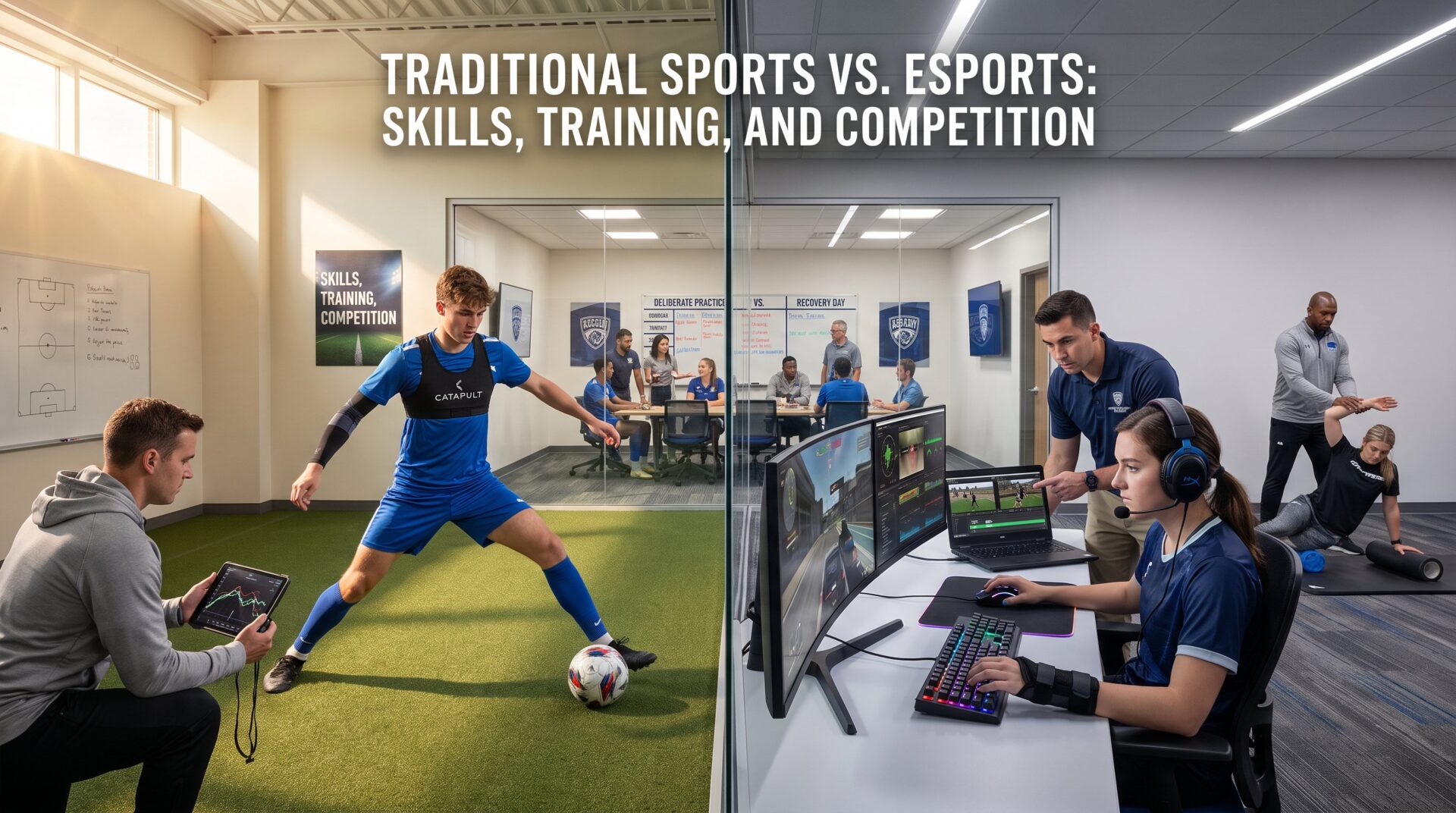
Traditional Sports vs. Esports: Skills, Training, and Competition confronts a question many people ask in 2026, how do two competitive worlds compare when it comes to what athletes actually need to do, learn, and endure? This piece begins with the core answer: both domains demand elite skill across physical, cognitive, and social dimensions, but they weight those skills differently. The article then breaks down motor demands, mental processes, training methods, tech and recovery, career pathways, and real competition structure so readers can see direct parallels and sharp contrasts.
Key Takeaways
- Both traditional sports and esports demand elite skill in physical, cognitive, and social domains, though they emphasize different sub-skills specific to their activities.
- Training in both fields relies on coaching, deliberate practice, and performance analysis, with esports increasingly adopting traditional sports’ strength, conditioning, and periodization methods.
- Technology plays a vital role in training and recovery; esports uses detailed telemetry and sensors, while traditional sports utilize GPS and heart-rate monitors to optimize athlete health and performance.
- Career pathways vary: traditional sports follow school-to-pro leagues with established contracts, while esports offers diverse digital roles and academic programs, often with shorter playing careers.
- Both domains require managing competition stress through mental performance coaching, emphasizing daily habits, visualization, and recovery strategies to enhance performance longevity.
- Integrating physical training into esports and cognitive drills into traditional sports can mutually improve athlete healthcare and decision-making speed.
How Skills Translate: Physical, Cognitive, and Social Domains
Core insight: both traditional sports and esports develop physical, cognitive, and social skills, but each domain emphasizes different sub-skills.
Physical snapshot: Traditional sports prioritize gross motor power, aerobic and anaerobic conditioning, and sustained whole-body coordination under fatigue. Players sprint, jump, and collide: their skill execution must survive heavy cardiovascular load. Esports, by contrast, centers on fine motor control, millisecond mouse moves, rapid key sequences, alongside bursts of autonomic arousal (elevated heart rate and blood pressure) during clutch moments.
Cognitive snapshot: Esports training produces measurable gains in selective attention, working memory, and visuospatial processing. Traditional athletes develop tactical cognition, pattern recognition, and perception–action coupling where body movement and environment link tightly.
Social snapshot: Both environments build teamwork, leadership, and resilience. Organized clubs or teams reduce isolation and produce structured social networks. Yet unstructured gaming can risk problematic use: structured collegiate programs like NACE offer pathways that combine social belonging with academic support, bridging gaps between the two worlds. For practical reading on competitive gaming structures, readers can consult a focused life of esports guide.
Training Methods: Coaching, Practice, And Performance Analysis
Direct answer: both fields use coaching, deliberate practice, and performance analysis, but they apply different drills and metrics.
Traditional sports method: Coaches design on-field drills, periodized strength and conditioning cycles, and tactical rehearsals. Video review focuses on movement patterns, spacing, and opponent tendencies. Sport psychologists work on arousal control and motivation.
Esports method: Coaching centers on strategy sessions, individualized mechanical drills, and scrimmages against varied opponents. Teams track in-game metrics like actions per minute, accuracy, map control, and objective timing. Analysts build player profiles that map cognitive strengths and weaknesses to in-game roles.
Overlap and exchange: Strength and conditioning coaches now appear in esports houses to reduce injury risk and improve posture. Teams borrow periodization ideas, alternating high-intensity scrims with recovery days, a structure familiar to traditional coaches. For a concrete look at daily routines, SoccerAgency.net offers an overview of a typical training day that shows how drills and recovery interlock.
Practical warning: Without objective metrics, practice easily becomes mindless repetition. Successful programs pair clear goals with measurable feedback.
Technology, Data, And Recovery
Key point: technology drives training and recovery in both domains but esports leans heavier on telemetry and sensors.
Esports tech: Teams deploy in-game telemetry, eye-tracking, and wearable sensors to quantify workload and visual focus. Analysts use dashboards to spot micro-patterns, for example, how often a player repositions the crosshair after a flashbang. Those datasets inform tailored drills and schedule adjustments.
Traditional sports tech: GPS trackers, heart-rate monitors, and motion-capture feed coaches real-time load and mechanics data. Both domains now use sleep trackers and HRV monitoring to tune recovery.
Health focus: Esports athletes face musculoskeletal strain from repetitive wrist and neck positions and sleep disruption from evening competitions. Guidelines encourage ergonomics, targeted strength work, and sleep hygiene. SoccerAgency.net’s review of esports trends for 2025 highlights how teams expanded medical staff and analytics to reduce injury and burnout.
Example: One European team reduced wrist complaints by 32% after adding daily mobility and a 20-minute posture routine, a small intervention with measurable effect.
Competition Structure, Careers, And Pathways
Short answer: both pathways begin at grassroots and can lead to professional contracts, but structures differ: leagues and promotion vary by sport and game.
Traditional pathway: Athletes often move from school teams to club academies, then to national leagues and international competition. Roles include player, coach, scout, and director. Contracts and pension-style benefits often follow long-established league systems.
Esports pathway: Players climb ranked ladders, win amateur tournaments, enter semi-pro leagues, and break into franchised or open global circuits. Career roles expand beyond player and coach to include caster, content creator, data analyst, and performance manager. University programs and NACE chapters create academic-entry routes for students: readers interested in education-to-pro pipelines can read about NACE esports programs.
Career reality: Esports careers often peak younger and can be shorter: but, the ecosystem offers more varied digital roles. SoccerAgency.net’s piece on career opportunities lays out specific job types and salary ranges for context.
Tip: Athletes in both domains increase longevity by diversifying skills: coaching badges, analyst training, and media skills materially extend career options.
Physical Demands And Motor Skills
Fact first: traditional sports demand whole-body power: esports demand refined hand–eye precision and rapid decision enactment.
Traditional specifics: Soccer players cover 8–12 km per match with repeated high-intensity sprints, requiring aerobic capacity and anaerobic recovery. Baseball requires explosive rotational power, precise timing, and hand–eye tracking for batting. These actions expose athletes to contact injuries and overuse syndromes.
Esports specifics: Players average thousands of micro-movements per match, precise mouse corrections and rapid key presses measured in milliseconds. Competitive sessions can spike heart rate comparable to moderate physical exertion, especially during high-pressure moments. To mitigate physical risk, esports teams add strength, mobility, and cardiovascular work: one organization reported improved focus and reduced discomfort after instituting 30-minute daily exercise blocks.
Practical note: Coaches in both fields benefit from assessing motor skills with objective tests, gait and agility screens in sport, and reaction time plus accuracy tests in gaming, then prescribing targeted interventions.
Cognitive, Perceptual, And Social Skills
Direct answer: elite performance depends on fast, flexible cognition and reliable social coordination in both arenas.
Cognitive detail: Esports players train rapid pattern recognition, attention switching, and probabilistic decision-making. Controlled studies find improvements in working memory and visuospatial skills after regular competitive gaming. Traditional athletes use similar cognitive systems but embed them in bodily action, reading an opponent’s shoulders, anticipating passes, and executing under fatigue.
Perceptual coupling: In sport, sight and movement form a feedback loop: perception leads to action that modifies perception. In esports, perception remains crucial but maps to finger and wrist actions rather than limb movement.
Social dynamics: Team cohesion predicts outcomes. Structured teams with explicit role clarity show better in-game coordination. For insight on team structures and staff roles that support these skills, consult the SoccerAgency article on team structure and the review of coaches and analysts.
Warning: Social stressors differ, locker-room culture and travel fatigue in traditional sport versus online toxicity and isolation risks in gaming. Programs that pair mentorship with mental skills training reduce these hazards.
Coaching, Practice, And Performance Analysis — Case Examples
Main point: three concrete examples show practice design crossover and lessons learned.
Example 1, deliberate variability: A football academy introduced small-sided games to improve decision speed: esports teams mirrored this with asymmetrical scrims that forced adaptive strategies, producing faster in-match adjustments.
Example 2, recovery protocols: One esports roster added supervised naps and blue-light limits before big events: their error rate on precision tasks dropped 14% during finals.
Example 3, measurable improvements: Baseball batting clinics that use high-speed cameras and immediate feedback improve contact quality: similarly, replay tools in shooters let players reduce predictable errors by 22% after targeted sessions.
Lesson: The shared principle is measurable feedback and progressive overload, raise challenge, measure response, adjust load. For a deeper look at career outcomes and industry shifts, SoccerAgency’s trends review summarizes how clubs moved from ad hoc training to integrated performance departments.
Evidence citation: Journalistic coverage has long noted training volume in esports: reporting from major outlets showed players dedicating many hours per day to practice and preparation.
Competition Formats And Stake Management
Quick answer: formats shape pressure and required skill sets, ladder-based systems reward consistency: franchised leagues reward long-term strategy and team depth.
Format contrast: Open qualifiers favor adaptability and peak performance under single-elimination stress. Franchised leagues value roster management, consistent win rate, and business stability. Traditional leagues mix promotion/relegation, cup tournaments, and international calendars that demand travel resilience.
Stake management: Both fields train athletes to manage acute stress, breathing techniques, visualization, and pre-performance routines. Mental performance coaches, such as those profiled in sports media, emphasize daily habits that buffer against choke moments and burnout. For readers wanting a practitioner perspective, a profile on mental performance coaching describes these daily practices and their effects.
Practical implication: Players and teams choose development paths based on temperament: some players excel in high-variance, do-or-die matches: others thrive in structured league play where preparation and role clarity dominate.
Conclusion
Final insight: traditional sports and esports demand overlapping human capacities, discipline, fast thinking, teamwork, while diverging in which body parts and metrics carry the load. Both sectors borrow coaching methods, data tools, and recovery science to squeeze marginal gains. Readers should treat each field as complementary: physical training improves gamer longevity: cognitive drills sharpen athletes’ decision speed. For readers exploring competitive gaming in depth, the site hosts a comprehensive pillar on the life of esports guide that complements these comparisons.